
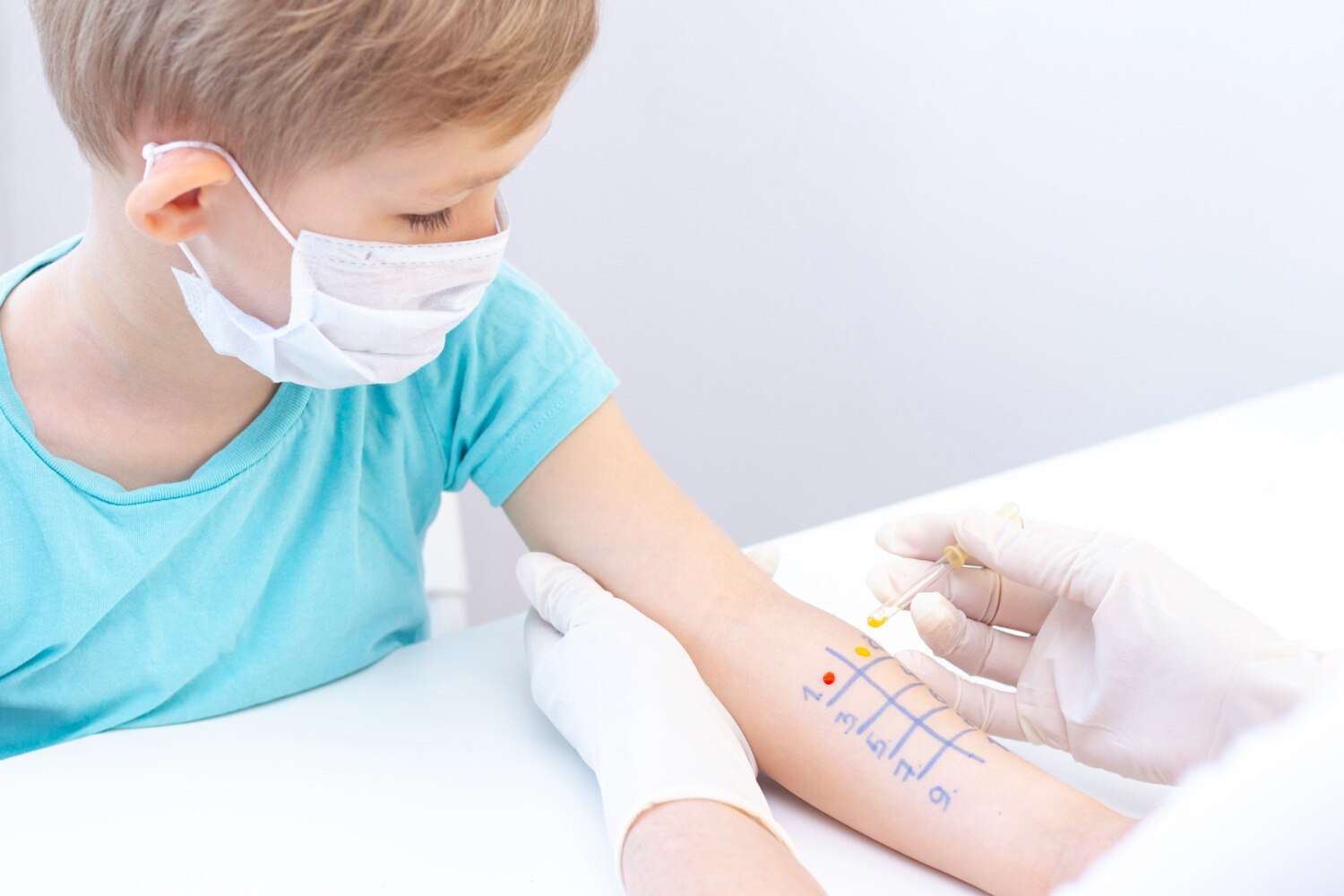
The right test depends on what happened, how soon symptoms appeared, whether the reaction repeats, and what the examination shows. By the end, you will know when skin-prick testing, a named IgE blood test, component testing, patch testing, or a different evaluation fits your child’s symptoms—and how to prepare for it.
Key takeaways
- Start with the reaction history and physical examination, not a broad commercial panel.
- Match the test to the suspected trigger and timing of symptoms.
- IgE blood tests target allergic sensitisation; general blood tests do not diagnose specific allergies.
- Compare test expertise, interpretation, safety procedures, and follow-up before choosing a clinic.
Does your child need allergy testing at all?
Most children do not need allergy testing immediately; the decision starts with a reaction history and physical examination, not a commercial broad panel. The clinician checks the suspected trigger, amount, timing, whether symptoms were immediate or delayed, and whether the same exposure produces the same reaction.
1. Testing fits a repeatable reaction that begins soon after eating or exposure, especially hives, facial swelling, vomiting, wheezing, or symptoms involving more than one body system. Record the food or exposure, quantity, ingredients, date, time to symptoms, and photographs in a diary.
2. Testing may not be the first step when symptoms better match a viral infection, irritant rash, reflux, lactose intolerance, untreated eczema, or asthma without a clear allergen trigger. A negative result will not explain every cause of these symptoms.
3. Eczema alone does not automatically require food testing. Persistent moderate-to-severe eczema despite appropriate treatment, or a specific immediate reaction to a food, gives the clinician a stronger reason to investigate; testing every food can produce misleading positives and unnecessary restriction.
4. Do not wait for outpatient allergy testing if breathing difficulty, throat or tongue swelling, faintness, collapse, or symptoms affecting multiple body systems follow an exposure. Seek urgent medical care for possible anaphylaxis.
For allergy testing for children in Pimpri Chinchwad, bring the diary, medicine list, ingredient labels, and rash photographs. This evidence helps the clinician choose whether testing is useful at all.
Which test matches the suspected trigger?
The suspected trigger and timing determine the test: immediate hives, swelling, vomiting, or wheezing point to IgE testing, while a delayed contact rash needs patch testing.
| Option | Best match | What happens |
|---|---|---|
| Skin-prick testing | Milk, egg, peanut, other foods; pollen, dust mite, mould, pet dander, or sometimes insect venom | A tiny extract is placed and lightly pricked into the skin. Results appear in 15–20 minutes. A positive result shows sensitisation, not definite clinical allergy. |
| Serum-specific IgE | A named food, inhalant, insect venom, or medicine | A blood sample measures antibodies. Use it when extensive eczema, an untestable skin surface, or interfering medicines make skin testing impractical. |
| Component-resolved diagnostics | Conflicting peanut or other allergen results, or a need to assess risk more precisely | The test examines individual proteins within an allergen rather than the whole extract. |
| Patch testing | Cosmetics, adhesives, preservatives, metals, or topical medicines causing delayed contact dermatitis | Patches stay on the skin and are checked after about 48 hours and again later. |
| Clinical assessment | Delayed or non-IgE-mediated food reactions | Prick and specific-IgE tests may miss these reactions, so diagnosis relies on the history, examination, and a clinician-directed plan. |
For pediatric allergy testing in Pune, tell the clinician whether symptoms began immediately or hours later. Report every antihistamine and medicine; antihistamines can suppress a skin response, and you should not stop prescribed treatment without advice.
A child allergy blood test Pimpri Chinchwad usually means serum-specific IgE, not a complete blood count or total-IgE test. Neither method is automatically more accurate, and broad food panels can produce misleading positives and unnecessary food restriction. Testing should target allergens that fit the exposure history.
What is the difference between an IgE blood test and a general blood test?
A targeted IgE blood test asks whether your child has antibodies to a named trigger. A child allergy blood test in Pimpri Chinchwad usually means serum-specific IgE for a particular food, insect venom, medicine, or inhalant—not routine laboratory work.
| Option | What it measures | What it can and cannot show |
|---|---|---|
| Serum-specific IgE | IgE antibodies to a named allergen | Supports sensitisation to peanut, milk, pollen, dust mite, or another selected trigger; it does not prove symptoms are caused by that allergen |
| Complete blood count | Blood-cell patterns, including eosinophils | A raised eosinophil count can support further evaluation, but cannot identify the responsible allergen |
| Inflammation tests such as CRP | General inflammation | Cannot confirm an allergy or name a food, pollen, or medicine |
| Total IgE | Overall IgE level | Can be high without clinical allergy and normal in a child with genuine allergic disease |
Do not use a high total-IgE result alone to remove foods or start allergy treatment. Broad food-IgE panels are also risky: irrelevant positive sensitisation results can cause unnecessary restriction, anxiety, nutritional gaps, and repeat consultations. The clinician should select allergens that match the child’s exposure history.
If the history and result disagree, a supervised oral food challenge can test tolerance using measured doses under medical observation. Never attempt it at home after a potentially serious reaction.
How do skin-prick and blood testing compare for a child?
Skin-prick testing is usually the quicker, less invasive choice; serum-specific IgE blood testing is useful when skin results cannot be trusted or antihistamines cannot be paused. Neither is automatically more accurate: interpretation depends on the reaction history, named allergen, and response size or concentration.
| Option | Practical advantage | Trade-off |
|---|---|---|
| Skin-prick | Results in 15–20 minutes; tiny extract; no blood draw | Antihistamines can suppress the response; needs reliable skin |
| Serum-specific IgE | Avoids antihistamine interference; suits extensive eczema or unusable skin | Requires a blood sample; results return later |
Report every antihistamine and other medicine before testing. The clinic may give medicine-specific instructions; do not stop prescribed treatment without medical advice. Fasting is usually unnecessary for either test, but confirm the clinic’s instructions.
Do not remove foods, pollen exposure, pets, or other suspected triggers before assessment unless a clinician tells you to; removal can obscure the history. Bring:
- Photos of rashes or swelling
- An exposure diary, ingredient labels, and medicine names
- Dates, amounts eaten, and symptom timing
For an allergy test clinic near me, choose a service where a pediatric clinician interprets results rather than a laboratory issuing numbers. A positive result shows sensitisation, not automatically clinical allergy, and a negative result does not explain every symptom.
Seek urgent care for breathing difficulty, throat or tongue swelling, faintness, collapse, or multi-system symptoms after exposure; do not wait for outpatient testing.
How should you choose an allergy test clinic near you?
Choose a clinic that can make a clinical decision, not merely print a number. For pediatric allergy testing in Pune, ask whether a pediatric clinician will take the reaction history, examine your child, select named allergens, and explain whether a result shows sensitisation or confirmed clinical allergy.
| Check before booking | What to confirm | Why it matters |
|---|---|---|
| Clinical assessment | A pediatric clinician reviews symptoms, timing, exposure and examination findings | A broad panel can create misleading positives |
| Reporting | The report names every allergen tested | Unexplained numbers cannot guide food avoidance |
| Safety | Trained staff and emergency treatment are available during testing | Immediate reactions need prompt treatment |
| Follow-up | The clinic explains conflicting results and offers specialist review | A negative result does not explain every symptom |
Ask what happens if symptoms and results disagree. A supervised oral food challenge, using measured doses under observation, can assess tolerance; never attempt it at home after a potentially serious reaction.
Before searching for an allergy test clinic near me, ask about antihistamine instructions, blood-sample requirements, result timing, supervised food challenges, and access to specialist review. Confirm that the service can assess allergy testing for children in Pimpri Chinchwad rather than selling a commercial panel.
Nestcare Mother and Child Care Clinic can be considered when families in Pimpri Chinchwad or Pimple Saudagar want testing, examination, interpretation and follow-up handled as one decision.
Related services
Blood Testing Services Blood Testing & Allergy Testing – Accurate Diagnosis for Better Health Blood tests and allergy testing play an important role in identifying... View service → |
Pediatrician Care: Expert Diagnosis and Treatment for Childhood Allergies Children experience the world through exploration, and their developing immune systems... View service → |
Frequently asked questions
Does every child with allergy symptoms need testing?
No. Testing starts with the reaction history and physical examination. The clinician considers the trigger, amount, timing, and whether symptoms recur after the same exposure.
Which allergy test matches a suspected trigger?
The suspected trigger and reaction pattern determine the test. A clinician may recommend targeted testing rather than a broad panel.
What is the difference between an IgE blood test and a general blood test?
An IgE blood test looks for sensitisation to selected allergens. A general blood test does not identify a specific allergy.
How do skin-prick and blood testing compare for a child?
Skin-prick testing provides a direct skin response, while blood testing measures allergen-specific IgE from a blood sample. The clinician chooses between them based on the child’s history and examination.
How should you choose an allergy test clinic near you?
Choose a clinic that offers pediatric assessment, explains why a test is needed, uses targeted testing, and provides follow-up to interpret the result.
Related services
Pediatrician Symptoms, Triggers & Pediatric Allergy Care Allergies in children are becoming increasingly common and can affect daily life in many ways—from mild... View service → |
Pediatric Dermatologist Allergic Skin Conditions & Rashes Specialized Care for Healthy Children’s Skin Children often experience skin allergies and rashes that can cause discomfort, itching, redness, and... View service → |
Pediatrician Pediatric Spirometry & Pulmonary Function Testing Understanding Your Child’s Lung Health Breathing is something we often take for granted—until a child starts struggling with cough, wheezing,... View service → |
Psychiatrist Treatment Eczema & Atopic Dermatitis Specialist Pediatric Eczema & Atopic Dermatitis Specialist – Gentle Care for Healthy Childhood Skin Eczema, also known as atopic dermatitis, is one of the most... View service → |
Keywords